










Face crop and alignment: the core's contract and test vectors
The face crop and alignment move from the phones into the Rust core (coordinator, 27 Nov; DECISIONS §5: "the face crop and alignment are done in the Rust core"), so his iPhone and an Android phone hand the face model the same 112×112 pixels. Today it is AlbumsAlign in apps/cotton/Sources/CottonUI/Albums/AlbumsAnalysis.swift; it is deleted once the core answers.
The contract
Input. An RGB picture (8 bits a channel, row by row from the top) and five points in pixel-index coordinates: the centre of the top-left pixel is (0, 0), x to the right, y down. The order is:
- the eye on the picture's left;
- the other eye;
- the nose tip;
- the mouth corner on the picture's left;
- the other corner.
Vision gives continuous coordinates (pixel centres at i + 0.5), so the iPhone subtracts 0.5 before calling.
Template. ArcFace's five points for a 112×112 face, in the same order:
| point | x | y |
|---|---|---|
| eye (left) | 38.2946 | 51.6963 |
| eye (right) | 73.5318 | 51.5014 |
| nose tip | 56.0252 | 71.7366 |
| mouth (left) | 41.5493 | 92.3655 |
| mouth (right) | 70.7299 | 92.2041 |
Transform. The similarity transform (scale, rotation, translation; no reflection, no shear) that best maps the five points onto the template, by least squares (Umeyama 1991 without reflection), with ms and md the means of the source points and the template points:
dst = [[a, -b], [b, a]] · src + [tx, ty]
a  = Σ(sx·dx + sy·dy) / Σ(sx² + sy²)      (s = src − mean(src), d = template − mean(template))
b  = Σ(sx·dy − sy·dx) / Σ(sx² + sy²)
tx = md.x − (a·ms.x − b·ms.y)
ty = md.y − (b·ms.x + a·ms.y)
Output. 112×112 RGB. Output pixel (u, v), integers, takes the source at M⁻¹·(u, v):
- bilinear interpolation over the four nearest pixel centres;
- a neighbour outside the picture counts as black (0, 0, 0);
- each channel is rounded to the nearest integer (halves away from zero) and clamped to 0–255.
Refusal. When the five points have no spread (all the same point), answer an error, never a crop.
Model input. Then the model's own scaling. For HyperFace-50k that is (x − 127.5) / 127.5, blue channel first. This stays with the phone's model call, or the core's if the model moves too.
The vectors
vectors.json holds six cases and one refusal. scripts/albums-align-vectors.py --out assets/design/albums/align regenerates them, with the same contract written in Python.
| case | tests |
|---|---|
| identity | points already on the template: the crop is the picture, byte for byte |
| larger | a face twice the template's size |
| turned | turned 20° |
| small-turned | a small face (about 16 px between the eyes), turned −35° |
| jittered | points off the template by noise: least squares, not exact |
| edge | a face at the corner: the crop reaches outside the picture, which must be black |
| no-spread | all five points the same: an error |
Each case gives:
- the picture's size and its source PNG, with the SHA-256 of its raw RGB bytes;
- the five points;
- the expected
a, b, tx, ty; - the expected crop PNG, with the SHA-256 of its raw RGB bytes.
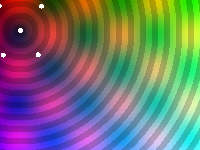
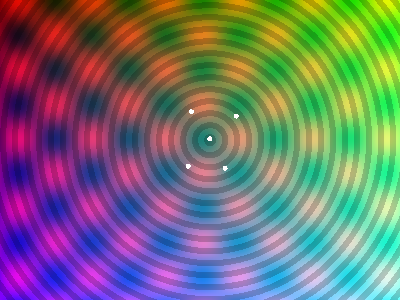
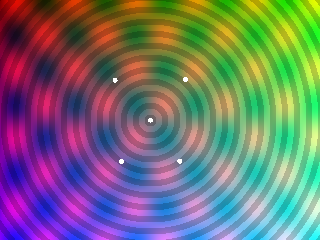
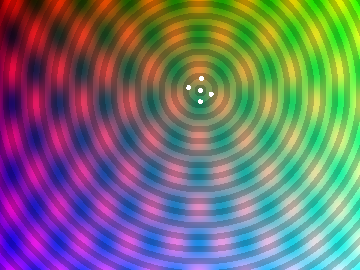
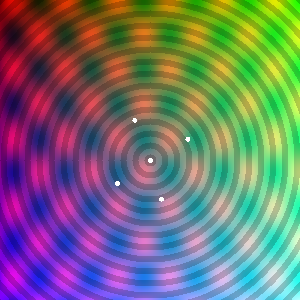
Each source has a white dot at every point, so in a right crop the dots sit on the template. The edge case's first dot is off the picture, so its crop is black there.
Tolerance: a, b, tx and ty within 1e-4, and every crop byte within 1 of the expected crop. A bit-exact match of the SHA-256 is not required, since floating point may differ by one in a rounding.
The phone today, against the vectors: AlbumsAlign (CoreGraphics) matches identity byte for byte. On the others it averages 1.1–2.5 per byte off, at most 84 at a dot's edge: the geometry agrees, but CoreGraphics' resampling is not plain bilinear. An Android phone would differ again, which is why the core does it.
Nothing in these pictures is a person. They are drawn from numbers, so the vectors carry no licence.